
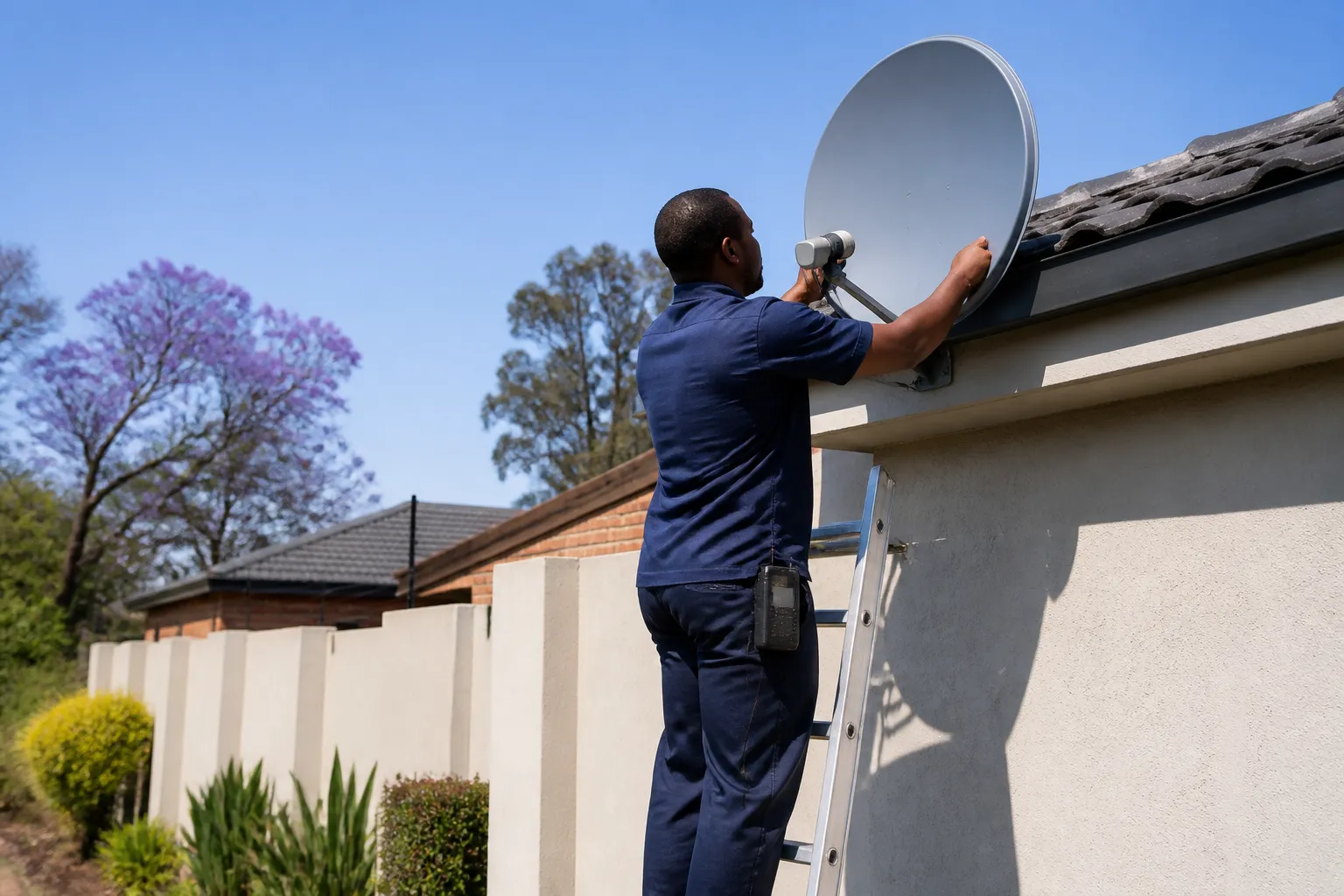
DStv Installer for Parkrand, Boksburg
Parkrand is a shade under four kilometres from the Boksburg town centre. Like everywhere on the Highveld, its summer afternoons can turn from clear to violent in half an hour, and satellite equipment lives outdoors through all of it. A good share of our Parkrand work is the day-after phone call: the picture has gone, or the decoder will not switch on at all, and the storm is the obvious suspect.
Rain fade is not a fault
During heavy rain the signal can weaken to the point where the decoder gives up, and you will often see an E48-32 — the weather-related version of the no-signal error. Nothing is broken. Water in the air between the dish and the satellite is absorbing the signal, every satellite system in the area is doing the same thing, and it clears when the weather clears. Waiting it out is the correct response.
What is not normal is a picture that does not come back once the sky has cleared. That usually means the storm did something physical: moved the dish, driven water into a connector, or damaged a cable. At that point it is worth a call, because the longer a wet connector sits, the more of the cable end corrodes.
Wind, hail and the decoder itself
A dish is a small sail on a stick. A gust can move one that is on a slightly loose bracket or an over-long mast just enough to cost you the signal, and it will happen again in the next storm unless the mount is dealt with rather than the aim. Hail can dent a reflector, though more often it takes out the plastic cap on the LNB and lets water in behind it, which does the same damage more slowly.
The decoder is the other casualty. A nearby lightning strike can put a surge down the mains or along the coaxial cable itself, and a decoder that is dead the morning after a storm has usually taken one or the other. The simplest protection costs nothing: when a storm is close, unplug the decoder at the wall. Doing that every time is more effective than most of what can be sold to you instead.
Building it to survive the next one
When we repair storm damage we look at why it happened, not just at what broke. That means a bracket sized for the dish and bolted into something solid, a mast no longer than it needs to be, every outdoor connector sealed, and cable clipped along its whole length rather than left in loops that can whip about. A dish that was properly mounted to begin with will normally come through a season untouched.
A check before the storm season is worth more than a repair during it. It is a short visit — alignment re-peaked on a meter, bolts checked, connectors opened and resealed, cable inspected for sun damage — and it is considerably cheaper than a new LNB and a lost weekend of sport.
What a visit to Parkrand covers
See the full list of DStv services we offer, or read about Extra View multi-room setups. Also nearby: Cinderella and Beyers Park.
Need DStv Sorted in Parkrand?
Send a photo of your dish and decoder on WhatsApp, or use the contact form, and we'll come back to you with a quote.
Call for a Quote